    |
|
|
|
 |
|
|

Yesterday, Germany marked a significant milestone in its military aviation with the news of the first flight of a Luftwaffe F-35A.
This first flight was announced this Tuesday, September 8, via a video published by Lockheed Martin Europe at 10:06 PM CET. The American company noted: "Germany's first F-35 takes flight. A major milestone for the program and a first look at German 5th-generation air power in the sky." Germany decided to acquire 35 F-35A aircraft in 2022. It is a model that 12 European countries have already committed to: Germany, Belgium, Denmark, Finland, Italy, the Netherlands, Norway, Poland, the United Kingdom, the Czech Republic, Romania, and Switzerland.
Die Zukunft der deutschen Luftwaffe hebt ab. 🇩🇪⚡
Die erste deutsche F-35 hat ihren Erstflug erfolgreich absolviert und damit einen bedeutenden Meilenstein für das Programm und die zukünftigen Fähigkeiten der Luftwaffe erreicht. pic.twitter.com/EEFgdXSKTe
— Lockheed Martin Europe (@LMEuropeNews) September 8, 2026
The video shows that this first F-35A is the MG-01, bearing the tail number 35+01. It displays the "Eiserne Kreuz" (Iron Cross —a Bundeswehr emblem with origins tracing back to the Teutonic Order) in a low-visibility version, making it the first German fighter model to feature the insignia in this style. Visible on the tail is the emblem of the German/US Air Force Tactical Training Command (GAFTTCOM USA); established on July 1, 2016, and based at Sheppard AFB (Texas), this unit replaced the former German Air Force Flight Training Center (GAFFTC)—based at Holloman AFB (New Mexico)—in 2019. GAFTTCOM USA will train German F-35 pilots.

Yesterday, the Luftwaffe posted these four photos of its first F-35A on Instagram—provided by Lockheed Martin—with this message: "The first test flight of the first German F-35, bearing the designation 35+01, took place today. It will be officially unveiled very soon."

In the first two photos, we see this first F-35A in a hangar in Fort Worth, Texas. In the third photo, we see the aircraft in profile, with the pilot in the cockpit.

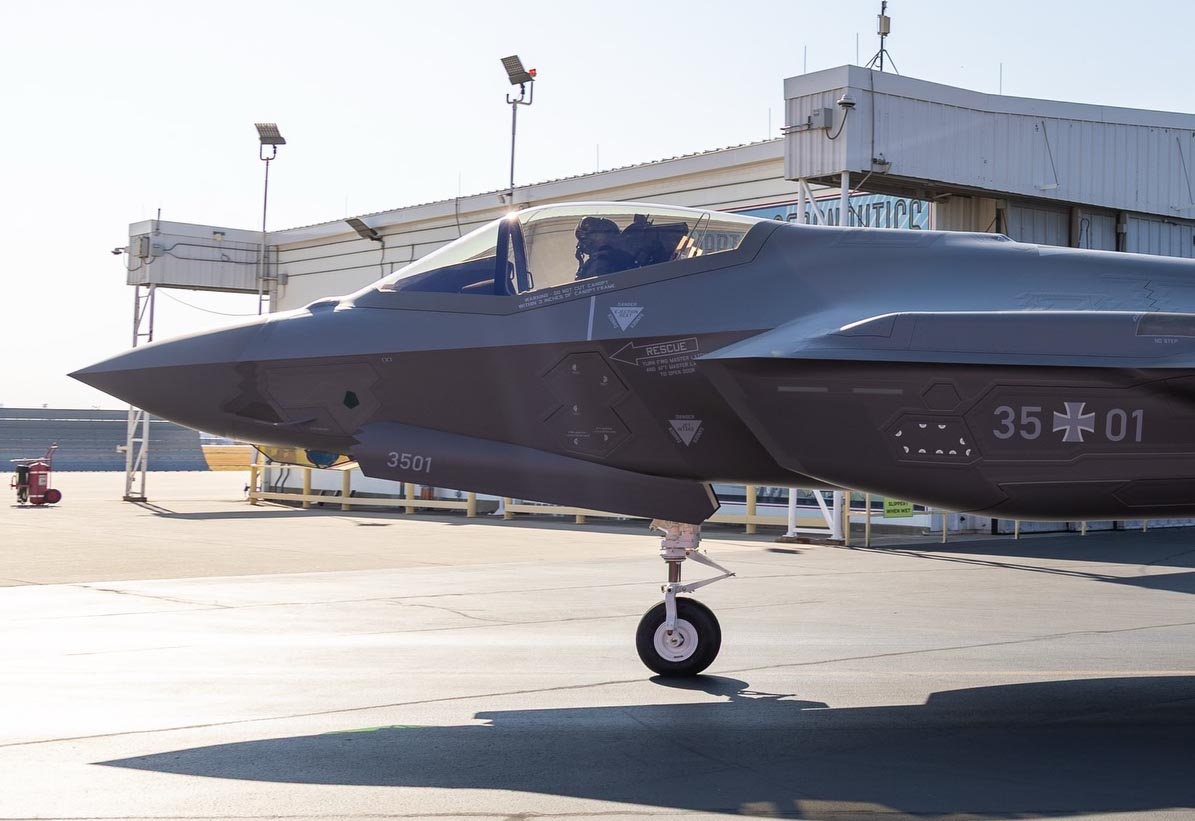
Here we can see the front section of the aircraft in greater detail. We can see the low-visibility Iron Cross and the number 35+01. In the Luftwaffe, unlike in other air forces, these numbers (officially designated "Taktische Kennzeichen", or Tactical Markings) indicate the aircraft type first. The "35" stands for the F-35; the Eurofighter is assigned the numbers 30, 31, and 34. The second part of the number indicates the aircraft's sequential number in the Luftwaffe registry. This is the first German F-35, so it bears the number 01.
On the rear section, we see the GAFTTCOM USA emblem on the tail fin (in a low-visibility version) and, above it, the aircraft's only splash of color: the black, red, and gold stripes of the German flag (in Germany, referring to the flag's color as "yellow" is frowned upon and was even declared a criminal offense in 1959, as it was a common Nazi slur against the Weimar Republic's flag). To the left, forward of the tail fins, we can see that the aircraft is fitted with radar reflectors, designed to increase its radar signature for air traffic control purposes. The Polish Air Force's first F-35s also carried them upon their arrival in Poland.

In the latest photo released yesterday by the Luftwaffe, we see the first takeoff of this first German F-35A.

In this close-up of the photo, we can see more clearly the radar reflectors installed just in front of the aircraft's two vertical stabilizers:

This first German F-35 places Spain in a curious position: it is the only Eurofighter program partner that has not yet purchased the stealth aircraft, despite currently having no other option to replace the Spanish Navy's Harrier IIs. The program's other three partners—Germany, Italy, and the United Kingdom—have already purchased the F-35, and in the cases of Italy and the United Kingdom, it is operated by both their air forces and navies.

Along with Spain, Germany is the Eurofighter program partner that remains most committed to this aircraft. The Luftwaffe currently has 138 Eurofighters in service, making it the largest operator of the type. Furthermore, Germany has purchased 38 Tranche 4 aircraft and 20 Tranche 5 aircraft. Spain is the second-most committed country, having approved the acquisition of 20 Tranche 4 and 25 Tranche 5 aircraft to replace its EF-18s. Unlike Spain, Germany has made a sensible decision: not to limit its air force's fighter fleet to a single model—a move that would create the risk of grounding the entire fleet in the event of a manufacturing defect.

Spain had hoped to acquire stealth aircraft in the long term through the FCAS program, but its cancellation has left those plans up in the air. For the moment, there is still no word on how Spain intends to fill the void left by the program's cancellation, all while the country is mired in a significant political crisis. General elections are scheduled for 2027, and a new government might opt for the F-35; however, as I noted here in October 2025, it is entirely possible that—prior to that—Pedro Sánchez’s government (which is very close to Turkey) could decide to back the Turkish TAI Kaan fighter —which made its maiden flight on February 21, 2024, and remains in the development phase—instead of choosing an American fighter like the F-35, thereby tying the next government's hands on this matter.
---
Photos: Lockheed Martin / Luftwaffe.
|
Don't miss the news and content that interest you. Join Defense and Aviation for free on Telegram: Click here to join |


Opina sobre esta entrada: