    |
|
|
|
 |
|
|

For many years, the word "cavalry" had become a term used to refer to certain units that no longer employ horses.
Hoy las unidades de caballería de los ejércitos modernos están formadas principalmente por vehículos acorazados en funciones de exploración. Casi todas las unidades de caballería tradicional dotadas con caballos tienen hoy una función ceremonial.

However, horses are reappearing for certain contemporary military functions. As you may recall, in 2021, the Polish Army resumed the use of horses to patrol Poland’s eastern borders—an area filled with marshes and characterized by a scarcity of primitive roads and paths, which are not always accessible to motor vehicles. In 2023, the Polish and British armies shared experiences during an exercise involving horses, conducted by the 2nd Lublin Brigade of Poland’s Territorial Defence Force (WOT) and a British armoured cavalry regiment, The Royal Lancers.
The British Army has now decided to test horses as an alternative means of countering a growing threat: drones. It may seem ironic that one of the most modern weapons can be countered using the oldest method of transport employed by armies—but, as the British Army explains in a video released a few days ago, it is perhaps not so ironic after all.

The unit chosen for this exercise is very well-known, although we are accustomed to seeing it in its elegant, historic uniforms during events involving the British Crown. It is the Household Cavalry Mounted Regiment (HCMR), a unit established in 1945 that currently consists of over 300 soldiers and approximately 250 horses.

The HCMR is part of the Household Cavalry (HCAV), which comprises two regiments. The other is the Household Cavalry Regiment (HCR), an armored cavalry unit. The HCAV is part of the British Army’s Household Division, which encompasses all the units tasked with guarding sites associated with the British Crown and rendering honors at its events.

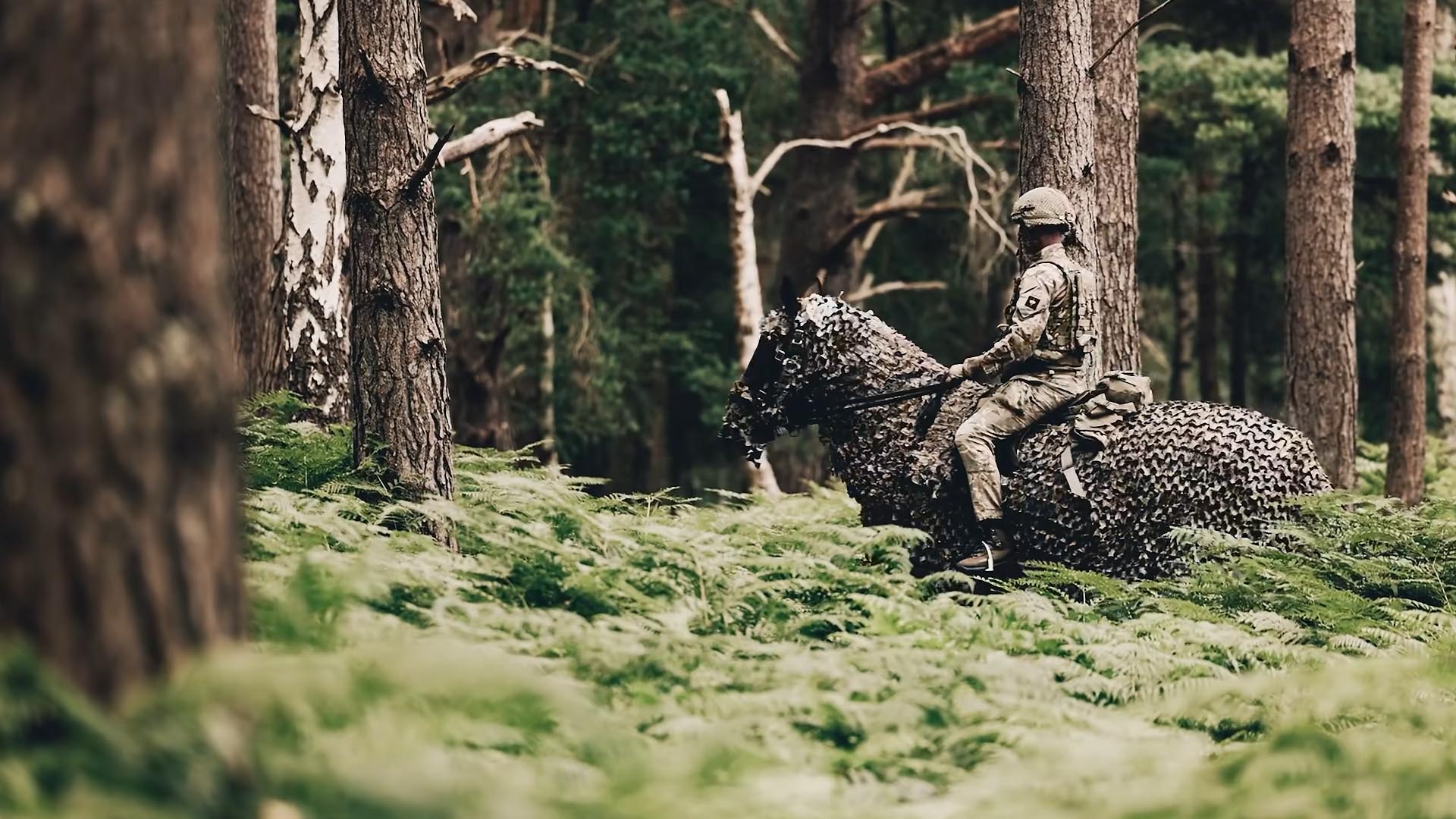
The exercise conducted this summer featured horses outfitted with camouflage netting, which was crafted by the regiment itself. This approach is very similar to the one adopted by the 13th Military Veterinary Unit of the Swiss Army, which we covered here in April.

The primary advantage horses offer over drones is their thermal signature. Although they are living beings, the heat emitted by a horse is significantly lower than that produced by the engines of wheeled or tracked military vehicles. The British Army’s video also claims that horses do not require fuel, but that is not entirely accurate. They do need fuel—it is simply more readily available to them than it is for motorized vehicles: they just need to find some good pasture.

It seems that the experience of this exercise has been very positive, and the riders of the HCMR have already requested to repeat it. I am a great fan of mounted cavalry, and, honestly, I am pleased to see that—in these times of drones and computers—man’s best friend (after the dog) is once again carving out a place for itself in military life, proving to be an effective solution for traversing difficult-to-access terrain while allowing soldiers to remain undetected.
---
Images: British Army / Wojska Obrony Terytorialnej.
|
Don't miss the news and content that interest you. Join Defense and Aviation for free on Telegram: Click here to join |


Opina sobre esta entrada: