    |
|
|
|
 |
|
|

On October 31, the 43rd Group of the Spanish Air Force concluded its 2026 forest firefighting campaign.
The campaign began on June 1st with the deployment of amphibious aircraft from the 43rd Group to detachments located at various points across Spain. Yesterday, the Air Force announced: "The 43rd Group maintains an alert service, ready to respond to forest fires 365 days a year. Between November 1st and May 31st, two aircraft and their crews are kept on standby for immediate takeoff at Torrejón Air Base," where the aforementioned unit is based.

Back in August, we looked at the impressive figures from the 43rd Group of the Air Force regarding their firefighting efforts this summer. It was an especially grueling campaign for these aircrews, given the severe wave of forest fires that struck Spain—with 302,074 hectares destroyed by fire, accounting for 42.8% of the total across the European Union, according to data from the European Commission’s European Forest Fire Information System (EFFIS), part of the Copernicus program. There were 477 fires, with a record 50,750 hectares consumed in a single day, July 5th. Furthermore, this year Spain experienced one of the deadliest forest fires in its history, with 13 fatalities in the blaze at Los Gallardos (Almería).

Yesterday, the Spanish Air Force reported the impressive figures for this campaign by the 43rd Group: "From June 1st to October 31st, the 43rd Group’s amphibious aircraft carried out a total of 539 firefighting interventions, logging 1,923 hours and 15 minutes of flight time and performing 5,293 water drops—an estimated volume of over 31 million liters. These figures reflect the intensity of the operational effort undertaken by the unit during one of the most complex campaigns in recent years." The report also highlights that between June 23rd and August 24th, "the 43rd Group maintained 61 consecutive days of operations, carrying out 451 interventions and completing over 4,542 water drops across 28 provinces and Portugal."

In its account of this campaign, the Spanish Air Force highlights the "human effort behind every mission," stating: "Alongside the flight crews, personnel in maintenance, operations, logistics, and other support services have played a fundamental role in ensuring the availability of the aircraft and the continuity of the missions, adapting to the demands of a campaign characterized by its intensity and the uncertainty surrounding activations."

However, it should be noted that this report omits an important detail: the number of aircraft available for this campaign. As I pointed out here four months ago, on May 21—before the start of this firefighting campaign—Prime Minister Pedro Sánchez announced "a fleet of 15 amphibious aircraft"—an incorrect figure, given that the 43rd Group has 14 aircraft. In the midst of a wave of wildfires, a surprise emerged: on July 9, the government acknowledged that only 7 of those 14 aircraft were operational, following the forced cancellation of a modernization program that the government had awarded to two companies that did not even possess the necessary licenses to carry out—or certify—such modernization.

According to data available online, the 43rd Group had not faced a campaign of this scale since 2012, when its aircraft logged 2,000 flight hours and performed 5,900 water drops. It should be noted, however, that these are not the most demanding figures the unit has ever had to contend with. As indicated on the website 43grupo.com, in 1985 the unit reached 3,100 flight hours in firefighting operations and carried out 9,200 water drops. That year was particularly tragic for Spain: 486,327 hectares were devastated across a total of 12,284 fires, which consumed 178,106 hectares of wooded land and 308,221 hectares of non-wooded land.
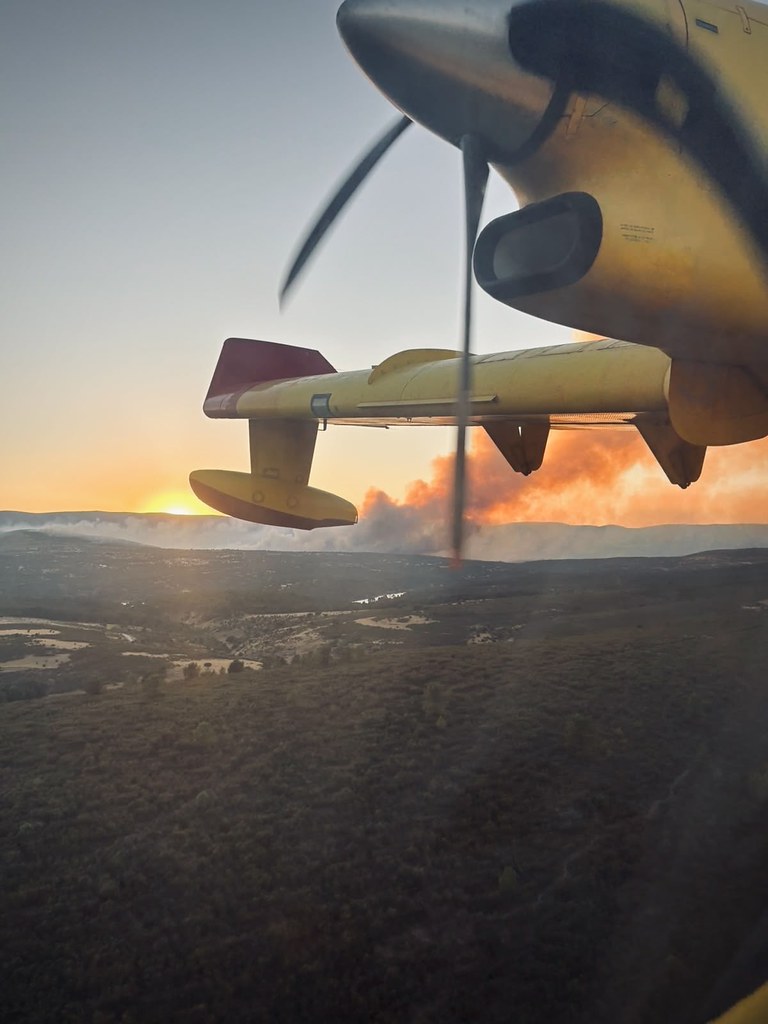
No amount of praise for the 43rd Group would be enough. Its pilots and ground crew do an admirable job. Hopefully, by next year, they will have more aircraft at their disposal, as Spain needs them to protect its forests.
---
Main photo: Elentir. Rest of the photos: 43 Grupo / Ejército del Aire / Ministerio de Defensa / Unidad Militar de Emergencias.
|
Don't miss the news and content that interest you. Join Defense and Aviation for free on Telegram: Click here to join |


Opina sobre esta entrada: