    |
|
|
|
 |
|
|

One of the most daring and successful air operations after World War II took place in the South Atlantic in 1982.
On April 2, Argentina launched Operation Rosario, capturing the Falkland Islands, a British colony 475 km east of Argentina's coast, that same day, and South Georgia (more than 2,000 km from Argentina) the following day. Ten days later, the United Kingdom established a 200-mile exclusion zone around the islands. The British government sent the Royal Navy and Royal Air Force to recapture the islands. On April 25, British forces recaptured South Georgia, and fighting for control of the Falkland Islands began on May 1.
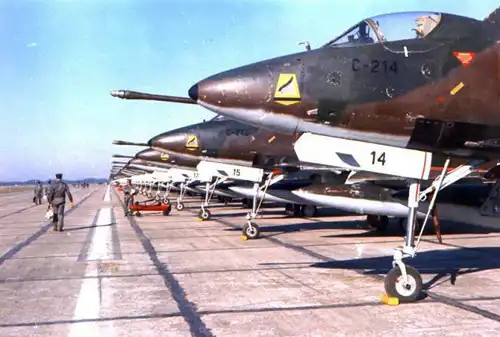
On May 25, the day Argentina celebrates the anniversary of the 1810 revolution that led to its independence, four Douglas A-4B Skyhawk attack aircraft of the Argentine Air Force's Fighter Group 5, under the command of Captain Pablo Carballo and flying from the Río Gallegos Military Air Base, carried out a daring attack operation against two British ships, the Type 42 destroyer HMS Coventry (D118) and the Type 22 frigate HMS Broadsword (F88).
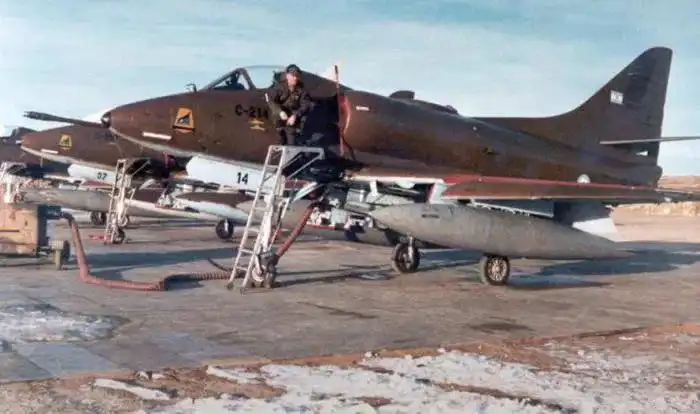
The British ships were sailing near Borbón Island, in the northwest of the archipelago. The Argentine planes flew very low, first taking advantage of the island's topography and then flying at sea level, so that the British ships' anti-aircraft defenses could not clearly detect the targets to lock on and launch their missiles until it was too late.
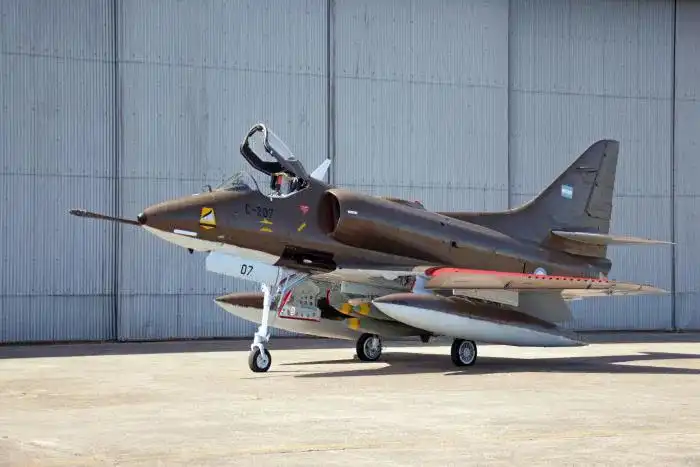
The A-4 Skyhawks attacked in two groups. The first, the Vulcano Section, was made up of the aircraft of Captain Carballo (the C-225) and Lieutenant Carlos Rinke (C-214) and were equipped (ironically) with a 454 kg British Mk-17 bomb each. This group attacked the frigate HMS Broadsword, piercing its hull, flight deck and Lynx helicopter with one of the bombs, which failed to explode.

The second group was the Zeus Section, formed by the planes of First Lieutenant Mariano Velasco (C-212) and Ensign Jorge Barrionuevo (C-207). These two A-4s carried three BR-250 bombs of 250 kg each (according to the book "La Fuerza Aérea en Malvinas. Volumen II", published in 2022 by the Comisión Batalla Aérea por Nuestras Islas Malvinas (BANIM). The BR-250s used by Argentina were low-drag (BR) bombs manufactured in Spain by Expal. They had been developed for the Spanish Air Force based on the American Mk.80 bombs and carried a 112 kg TNT or Tritonal warhead.

The three bombs from Lieutenant Velasco's plane hit HMS Coventry, lodging in the ship's hull due to their light weight compared to the Mk-17s. A British source describes what happened next as follows:
"The first bomb hit the port side of the hull, about 3 feet above the waterline, below the bridge (just under where the painted-out D118 pennant number was beginning to show through once more), passing through the computer room and lodging in the conversion machinery room below. The second bomb entered through the side of the superstructure just forward of the life raft stowage and tore through the main fore/aft passageway, breaking a hydraulic ring main and starting an immediate fire and passing through the naval store room below before probably lodging in the provision store below that. The third bomb hit the outer deck edge in the area of the Olympus engine intake grilles – outboard of the foremast – and lodged in the aft part of the forward (Olympus) engine room.
Seconds later, Barrionuevo’s Skyhawk flashed across the top of the ship – but despite pressing his bomb release, none of his bombs left his aircraft. Two witnesses onboard Coventry reported a single ‘bomb’ tumbling overhead at this stage, however – it may have been that this second Skyhawk released a drop tank in error."
Several seconds passed without anything happening, as the BR-250 bombs had time-delay fuses. Then, HMS Coventry was rocked by a series of loud explosions and began to list to port. Although the order to evacuate the ship could not be given, as it was so damaged that internal communications failed, the crew's professionalism in evacuating it meant that of the 287 crew members only 19 died (another crew member died a few months later as a result of his injuries). The ship's commander, Captain David Hart-Dyke, was the last to abandon the ship after ensuring that his men were safe.

Although Argentina lost that war, the attack of May 25, 1982, was a milestone for the Argentine Air Force. Using obsolete aircraft and armed with conventional bombs instead of anti-ship missiles, they managed to sink a destroyer, an operation that shattered many war manuals of the time. It was a success due both to the audacity of the Argentine pilots and the British's fatal underestimation of their rivals. Yesterday, the Yarnhub channel published an excellent video recreating this historic attack on computer (the video is in English but has an audio track and subtitles in English; you can activate them in the bottom bar of the player):
---
Main image: Yarnhub.
|
Don't miss the news and content that interest you. Join Defense and Aviation for free on Telegram: Click here to join |


Opina sobre esta entrada: