    |
|
|
|
|
|
|

January 27 marks the International Day of Commemoration in Memory of the Victims of the Holocaust, the colossal genocide perpetrated by the nazis.
The reason the UN chose that day is because on January 27, 1945, Soviet troops arrived at Auschwitz, the largest extermination camp built by the Germans. The very choice of the date is often used to create a narrative in which the Soviet Union is presented as the liberator of the Jewish people after the Holocaust. However, the role of that communist dictatorship in that genocide is not exactly honorable.

The German-Soviet alliance to invade Poland in 1939
We must not forget that the greatest number of Holocaust victims occurred in German-occupied Poland, and that the invasion of Poland was made possible by the Ribbentrop-Molotov Pact signed between Nazi Germany and the USSR on August 23, 1939, a week before the invasion. In the secret protocol of this pact, Hitler and Stalin divided Poland between them, acting in practice as allies and even organizing a joint German-Soviet parade in Brześć Litewski to celebrate their victory over the Poles.
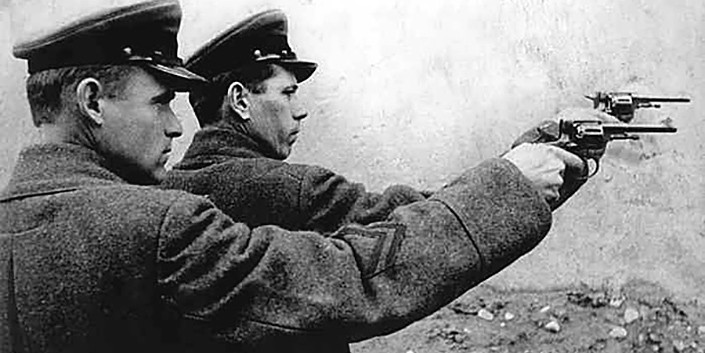
The handing over of German Jews to the Gestapo by the Soviet NKVD
Until the German invasion of the USSR on 22 June 1941, Hitler and Stalin continued to act as allies to an extent that many are still unaware of today. In the autumn of 1939 the Gestapo and its Soviet counterpart, the NKVD, began a series of joint meetings between 1939 and 1940 to share information and experience, with a particular focus on the liquidation of the Polish resistance. As part of that collaboration, the NKVD handed over to the Gestapo some 4,000 German communists and Jews who had taken refuge in the USSR.

Auschwitz I was created in the midst of the German-Soviet alliance
It was during the period of joint German-Soviet occupation that the Third Reich began building the Auschwitz I extermination camp in May 1940. The first prisoners to be imprisoned were 728 Polish political prisoners, mostly Catholics but also some Jews, who were brought there by train from Tarnów prison on 14 June 1940. The extermination aims of the new camp were made clear in the first speech given to the prisoners by SS-Hauptsturmführer Karl Fritzsch, as recorded by Danuta Czech in "Kalendarz wydarzeń w KL Auschwitz" (1992):
"You have not come here to a sanatorium, but to a German concentration camp, from which there is no other way out than through the chimney. If anyone does not like it, he can go straight to the wires. If there are Jews on the transport, they have the right to live no more than two weeks, priests one month, the rest three months."
SS chief Heinrich Himmler visited the camp for the first time in March 1941, and decided to begin construction of Auschwitz II (Birkenau) camp, three kilometres away.

The trade alliance between Germany and the USSR between 1940 and 1941
To the above it must be added that in February 1940 Germany and the USSR signed a Trade Agreement by which Germany received from the USSR 1.6 million tons of grain, 900,000 tons of oil, 500,000 tons of iron ore and other large quantities of raw materials sent by the USSR, essential material for manufacturing weapons and uniforms, feeding its troops and providing fuel for its tanks and planes. Hitler would not have been able to send and maintain his armies in Norway, France and North Africa without this Soviet aid, which also fueled the repressive machinery of the Nazis against Catholics and Jews in German-occupied Poland.
The Soviet silencing of the Jewish Holocaust after the war
If the collaboration between Nazi Germany and the USSR in the early days of the Holocaust is already unknown to many, the Soviet concealment of the Jews as the main victims of the genocide committed by Nazism is even more unknown. Historian Catherine Merridale, in her book "Ivan's War: Life And Death in the Red Army, 1939-1945" (2007), explains it thus: "Russia's access of outrage—and Stalin's preeminence within it—could not have been sustained if two specific truths had been considered. First, the group that faced the Nazis' most concentrated violence, a cruelty unparalleled even in this most vicious war, was not the Russian people but the Jews. Second, Soviet citizens in the occupied zones, including thousands of Ukrainians and Baits, had not only colluded in the genocide but welcomed and abetted it."
"Moscow could never approve of the mass killing of Jews", notes Merridale, but neither was it eager to accord them a special place in the myth of the war. For Russia to do so would have meant sharing its victimhood; its Communist leadership would also, by implication, have been forced to countenance the idea of a special closeness between Jews and Bolsheviks, a notion that Stalin had done his best to extirpate (not least by arresting Jewish comrades) for years." Such a distorted view of the Holocaust would have visible effects on Soviet propaganda and even on the treatment of Nazi crimes.
In his book "Bloodlands" (2010), historian Timothy Snyder notes: "The number of Jews killed by the Germans in the Soviet Union was a state secret." The reason for this secrecy was that "the Germans had murdered more Jewish civilians than Russian civilians in the occupied Soviet Union. Jews were in a category of their own, even by comparison with the Slavic peoples who had suffered more than the Russians, such as Ukrainians and Belarusians and Poles. The Soviet leadership knew this, and so did Soviet citizens who lived in the lands that the Germans had occupied. But the Holocaust could never become part of the Soviet history of the war."

The disastrous role of the Soviet team at the Nuremberg trials
At the Nuremberg Trials the Soviets were represented by Iona Nikitchenko, who had led trials in Stalin’s Great Purge of 1936-38. Ironically, three of the Nazi leaders were charged with conspiracy to invade Poland, but there was no rebuke to the Soviets for having participated in the invasion in alliance with Germany. During the trials the Soviets denied the existence of such pacts, even though the original document was found by British troops occupying Germany.
Likewise, during the trial, Soviet influence was evident in the indictment on war crimes, which included only seven mentions of Jews. When detailing the victims of the extermination camps, the omissions are striking: "About 1,500,000 persons were exterminated in Maidanek and about 4,000,000 persons were exterminated in Auschwitz, among whom were citizens of Poland, the U.S.S.R., the United States of America, Great Britain, Czechoslovakia, France, and other countries." Not a single mention of Jews (who were 960,000 of the 100,000 Jews) 1,085,000 murdered in Auschwitz) nor in the Sobibor and Treblinka camps, where the vast majority of those murdered were Jews.

The Soviet cover-up of the Holocaust: the case of Babi Yar
Something similar happened with the terrible massacre at Babi Yar in Ukraine, where "more than 100,000 of the city's inhabitants, including almost 34,000 Jews, were shot in September 1941," as historian Olga Baranova notes in "Politics of Memory of the Holocaust in the Soviet Union". It took the USSR many years to erect a monument to the victims, and when it did so in 1976, the following inscription was placed on it: "Here in 1941-1943, the German fascist invaders executed more than 100,000 citizens of Kiev and prisoners of war." "Despite the fact that more than 30 percent of the victims killed by the Nazis at Babi Yar were Jews, there was no reference to the Jewish tragedy," Baranova notes, prompting criticism among Soviet Jews.
As late as 2019, the Russian Foreign Ministry defended the 1939 German-Soviet pact, claiming: "Hundreds of thousands of lives were saved.", without mentioning the extermination of Polish Catholics and Jews initiated by the Germans in 1939 thanks to their alliance with the USSR. An example of the extent to which Putin's government continues to adopt Stalinist propaganda.
|
Don't miss the news and content that interest you. Join Counting Stars for free on Telegram: Click here to join |







Opina sobre esta entrada: