    |
|
|
|
|
|
|
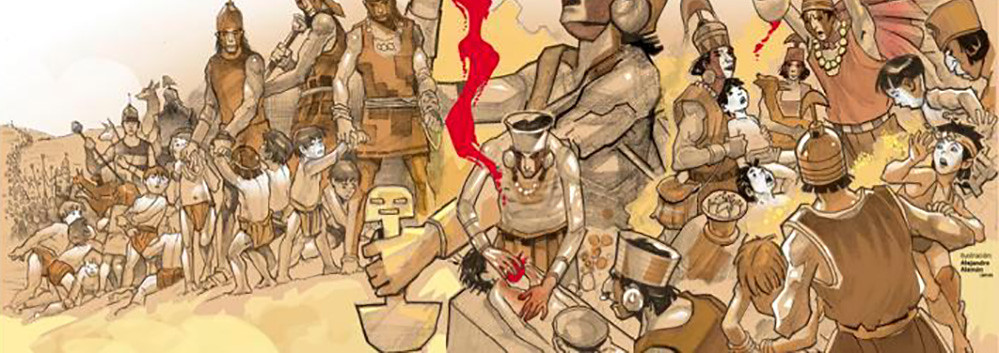
At the end of August, a Peruvian newspaper published a chilling news story about the Huanchaco Holocaust, perpetrated in the first half of the 15th century in what is now northwest Peru.
They opened the chests and ripped out the hearts of dozens of children in a single day
This is what the aforementioned news article from the Peruvian newspaper La República says: "Not even in the most blockbuster horror movie has such a gruesome ceremony been seen as the one that occurred a little over 500 years ago in the sand dunes surrounding the Huanchaco beach resort in Trujillo. The mud left by a flood caused by an El Niño phenomenon was still fresh when dozens of girls and boys were sacrificed in the most atrocious way: each one had their chest opened, their sternum separated, and their heart ripped out. They did the same with dozens of llamas. They tied their legs before extracting their hearts." You can see the video published by the Peruvian newspaper in its news report:
According to La República, this massacre took place in a single day. The exact date will never be known, but analyses point to the period between 1400 and 1450, that is, a century before the Spanish conquest of Tawantinsuyo. The article includes statements from Dr. Gabriel Prieto Burmester, director of the archaeological team working on the excavations at Huanchaco, in Trujillo: "In the Huanchaquito area we have unearthed 140 girls and boys, but just one kilometer away, in Pampa La Cruz, we recently discovered 122 bodies of children who were also sacrificed. We don't know if it was in the same event." Pre-Columbian Peru was not the only place where these monstrous practices occurred. La República also notes that in Mexico, "archaeologist Leonardo López Luján discovered evidence of a mass sacrifice of 48 children".
The precedent for the macabre findings in Tenochtitlán, Mexico
The sacrifices reported by the newspaper La República were committed by the Chimú culture, which inhabited the northern coast of what is now Peru. It was not the only pre-Columbian culture in the Americas to commit such atrocities. Last year, a tower of skulls was discovered in Tenochtitlán, Mexico a monstrous Aztec monument already witnessed by Andrés de Tapia, a companion of Hernán Cortés, in 1521. Many considered his testimony a fabrication created to justify the conquistadors' fight against the Aztecs. In the end, archaeology proved it to be true. As I already pointed out here, in a letter dated 1524, Friar Juan de Zumarraga, the first Bishop of Mexico, noted that in Tenochtitlán they sacrificed more than 20,000 people to their idols each year and more than 72,000 throughout the Aztec Empire, including 20,000 children. The Mexican historian Mariano Cuevas (1879-1949) put the number of sacrifices at 20,000 annually in Tenochtitlán, and noted that "we fall short" if we estimate the number of sacrifices perpetrated throughout the entire empire at 100,000 per year. Anáhuac, the name given by the Aztecs to their empire.
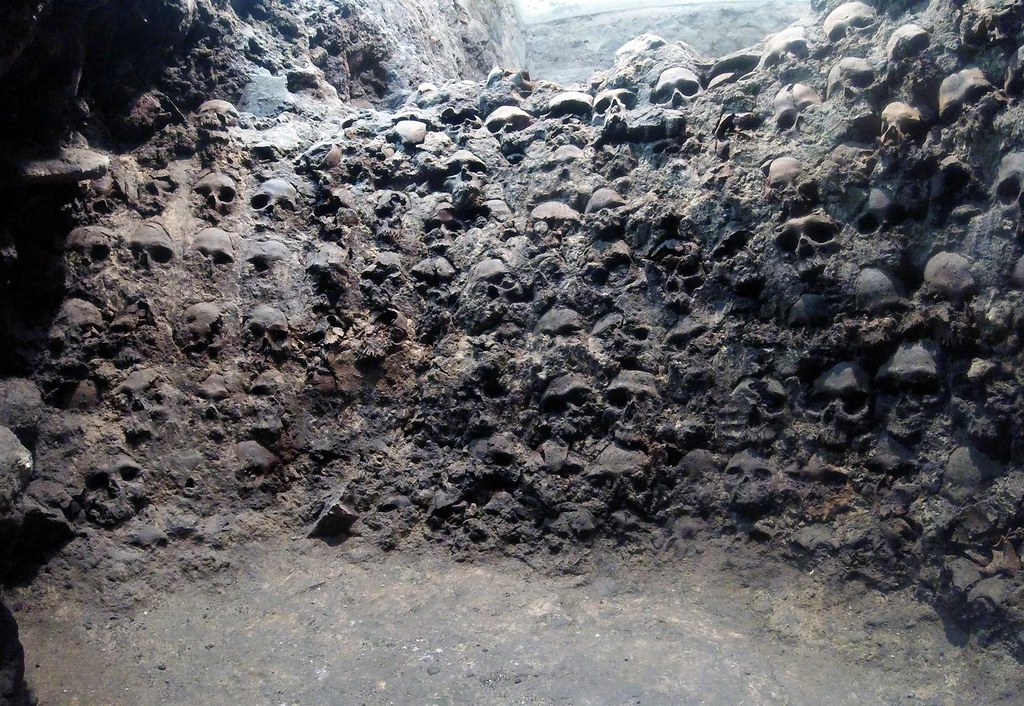
Skull Tower in Tenochtitlán, with the remains of men, women, and children who were victims of human sacrifices in the Aztec Empire
Archaeology is dismantling the anti-Spanish Black Legend
For some time now, the far-left in several American countries has spread a negative narrative about Spanish America, accusing Spain of committing "genocide", a false accusation often associated with attacks on Christianity and even the Spanish language, which were the two main civilizing elements of Spain in the New World. Of course, the Spanish presence on that continent was not without its errors and abuses, but it is far from what this negative narrative claims. In fact, if anything can be said about the Spanish, it is not that they committed genocide, but that they put an end to one: the genocide committed by peoples such as the Aztecs, the Incas, the Olmecs, the Teotihuacans, the Toltecs, the Totonacs, the Moche, and the Muisca against their neighbors and even against their own compatriots, including children. Archaeology is now demonstrating the falsehoods of that Black Legend, which was associated with a rosy legend about pre-Columbian America, as if it were a paradise of peace, tolerance, and harmony.
Let's imagine for a moment what some would say if the evidence of human sacrifices in the Americas pointed to the Spanish and not the pre-Columbian cultures: right now, the far left would be promoting a much fiercer anti-Spanish campaign than the current one. The paradox is that many inhabitants of present-day Latin America are descendants of Spaniards, who, far from creating racial barriers like those established by the British in North America, mixed with the indigenous population in an example of mestizaje (racial mixing) that is quite rare in human history. In fact, far from having racist aims, Spain founded 23 universities in the Americas open to indigenous people starting in 1533, when the College of Santa Cruz was built in Tlatelolco, in New Spain (present-day Mexico), which was the first institution of higher education on the entire continent. In North America, non-white students could not access any university until well into the 19th century. It's high time we decided to put an end to so much anti-Spanish propaganda, myths based on blatant lies that aim to rob the inhabitants of Latin America of their cultural heritage. It's as absurd as if they wanted to take away our Latin roots from the Spanish people.
---
|
Don't miss the news and content that interest you. Join Counting Stars for free on Telegram: Click here to join |




Opina sobre esta entrada: