    |
|
|
|
 |
|
|

This week, the decision of Pedro Sánchez's government to not purchase the US-made F-35 stealth fighter jets was announced.
The decision became known in an unusual way: through a leak to the socialist newspaper El País, without official confirmation from the government (nor is there any need for it, since it has been using that media outlet as its unofficial newsletter for years) and stating that Spain will seek "European alternatives", a statement that sounds like a bad joke, since there is no European alternative to the F-35B, the only possible replacement on the market for the Spanish Navy's Harrier II. There are no other STOVL (short takeoff and vertical landing) fighters available.

At the end of June we already saw the possible alternative for the Spanish Navy: a large CATOBAR-type aircraft carrier that could operate aircraft like the French Rafale M. The problem is that the government has not shown even the slightest interest in this idea, which in fact is not the first time it has been proposed. Thus, with the data we have now, the only thing we can conclude is that the Spanish Navy will run out of carrier-based fighters around 2030, when the Harrier IIs will reach the end of their operational life. In this way, a key capability in amphibious operations, that of close air support, will be lost, since the possible purchase of carrier-based attack helicopters to fill this gap has not even been considered.

The obvious question is: How did Spain get to this point? How did we go from having carrier-based fighters for decades to running the risk of losing that capability? The current government, which has let time pass without addressing this issue, bears a great responsibility, as it has systematically ignored the Navy's recommendations on the matter for at least five years. However, the political responsibility for this situation does not end with the current government.
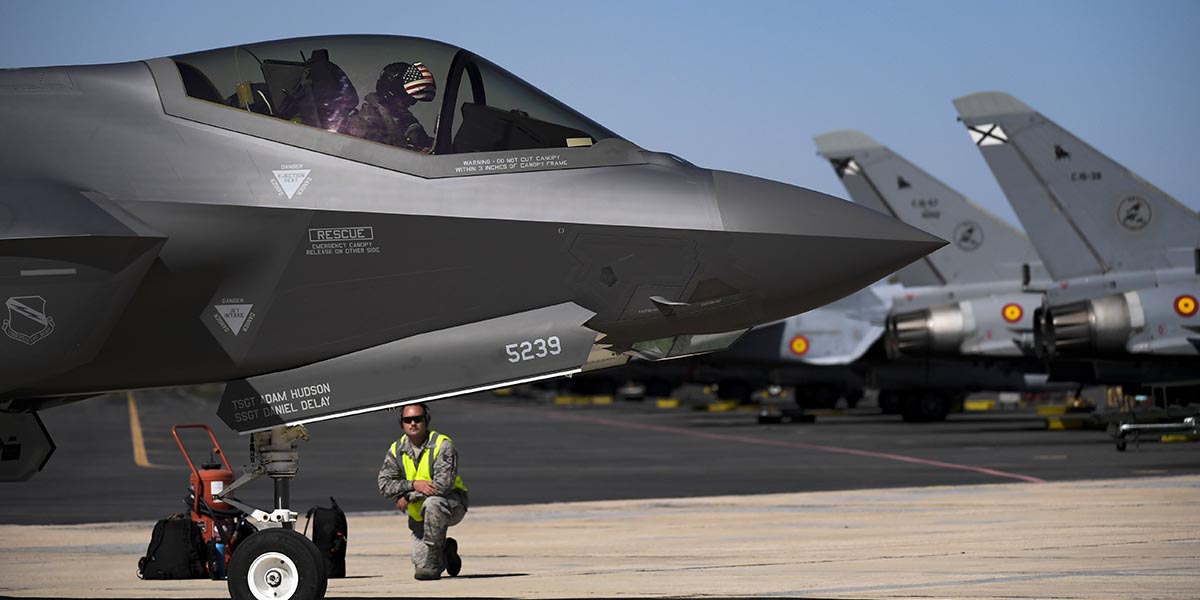
It's worth remembering that F-35 development began more than 30 years ago. The United States didn't shoulder the costs of this program alone. Other countries joined the project as partners at different levels. The United Kingdom joined the Joint Strike Fighter (JSF) program in 1995 as the sole Tier 1 partner. In 1997, Canada took the step as a Tier 3 partner. Italy and the Netherlands joined as Tier 2 partners in 2002. That same year, Australia, Denmark, Norway, and Turkey joined as Tier 3 partners (Turkey was expelled from the program in 2019 for its decision to purchase Russian S-400 missiles).

All of these partners in the JSF program acted with great foresight, investing large amounts of money in its development. Taking into account the years indicated, Spain could have shown interest in this program during the governments of Felipe González (PSOE, 1982-1996), José María Aznar (Popular Party, 1996-2004), José Luis Rodríguez Zapatero (PSOE, 2004-2011), Mariano Rajoy (Popular Party, 2011-2018) and Pedro Sánchez (PSOE, since 2018), who are the ones who could have made the decision to support this program, necessary to replace the Spanish Harrier IIs.

However, none of these Spanish governments showed any interest in this program, not even the Aznar government, which had a strong rapport with the US during the first years of George W. Bush's term (2001-2009). We can attribute this lack of interest to a combination of factors: short-termism (one of the most regrettable political flaws of Spanish governments in recent decades), the lack of a solid defense culture (both politically and socially: this is the factor that explains why Spain is one of the European countries that invests the lowest percentage of its GDP in defense), and also, in some cases, hostility toward the US, especially among socialist governments.

It should also be noted that buying the F-35B would have required a significant investment in the Navy, not just in the aircraft, since the Juan Carlos I L-61 aircraft carrier would need major overhauls to be able to operate those aircraft, if feasible. In the end, all the governments mentioned have acted as worthy heirs of some Spanish governments of several centuries, which decided to keep the Navy below its funding needs. Most Spaniards do not believe that a war could ever affect them and believe that investing money in defense is a waste, even with a neighbor as hostile as Morocco. One day we will regret having fueled that lack of foresight.
---
Photos: U.S. Navy / Elentir / U.S. Marine Corps / STRIKFORNATO.
|
Don't miss the news and content that interest you. Join Defense and Aviation for free on Telegram: Click here to join |


Opina sobre esta entrada: