    |
|
|
|
|
|
|
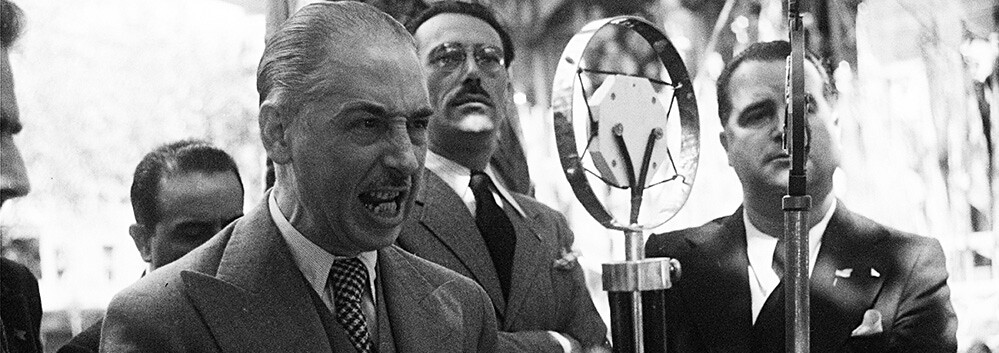
On this day, October 15, 1940, Lluís Companys i Jover—the leading figure of the Catalan separatist movement during the Second Republic—was executed by firing squad at Montjuïc Castle in Barcelona.
The execution by firing squad of Companys—one of the founders of the Republican Left of Catalonia (ERC)—turned him into one of the greatest icons of the separatist cause. In order to transform him into their martyr, Catalan nationalism had no qualms about concealing his crimes. A clear example of this brazen effort to hide the truth and whitewash his record can be found in the biography published on the website of the Presidency of the Generalitat: the text omits any mention of the deaths caused by the separatist coup d’état led by Companys—in fact, the website does not even label it a coup, instead justifying it by citing "the conservative regression of the republican regime and the threats against Catalan autonomy"—and it also conceals the thousands of murders committed under his command during the Civil War. This same falsification of history is what is imposed upon children in Catalan public schools. Since the Generalitat won’t tell you, I will.
In 1934, he led a separatist coup against the Second Republic
Following the victory of the center-right in the first elections in Spanish history to include women’s suffrage—held in November 1933—Companys led a separatist coup d’état against the Second Republic on October 6, 1934. The leader of the ERC demanded that the Army place itself under his command; the Captain General of Catalonia, General Domingo Batet, refused, remaining loyal to the government of the Republic and declaring a state of war. That same night, supporters of the separatist coup took to the streets armed—including paramilitary groups from leftist parties equipped with rifles—and erected barricades. When a group of soldiers loyal to the Republic arrived at La Rambla de Santa Mónica to read the proclamation declaring a state of war, the separatists initiated combat by firing upon the soldiers, resulting in one death and several injuries.
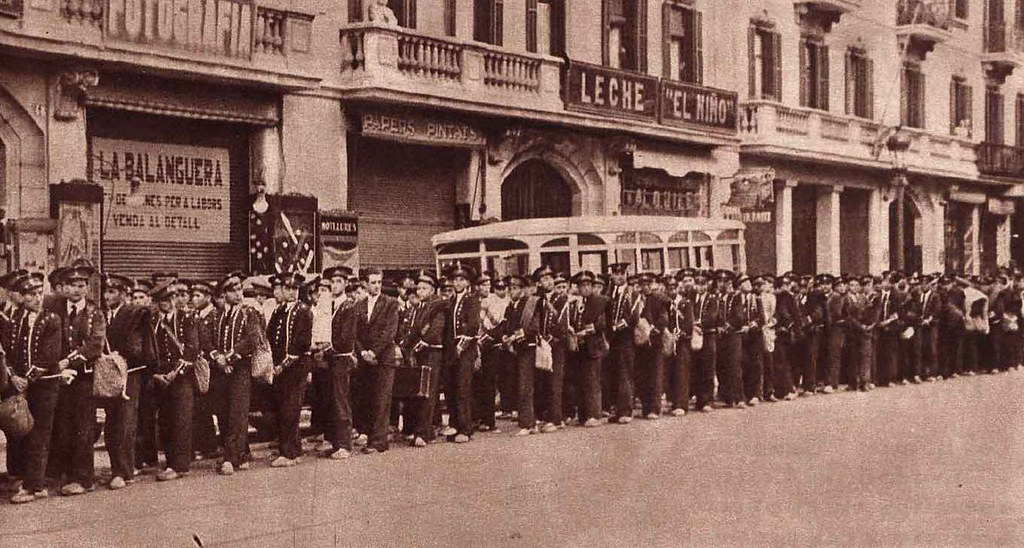
Mossos d'Esquadra arrested for their participation in the coup d'état of October 6, 1934.
The coup, supported by the Mozos de Escuadra, left 107 dead
In addition to receiving support from the aforementioned paramilitary groups and some members of the Guardia de Asalto (Assault Guard), the separatists employed the Mozos de Escuadra as an armed force during the coup. The fighting ended the following day when the separatists surrendered to the Army. General Batet used only the force strictly necessary to bring the situation under control, with as little bloodshed as possible. In the 10 hours it lasted, Companys’ coup left 107 people dead. He and his government were tried by the Court of Constitutional Guarantees and sentenced to 30 years in prison for military rebellion. Companys was incarcerated at the Puerto de Santa María prison (Cádiz). Despite his sentence, he spent only 16 months in prison. Immediately upon the Popular Front’s rise to power in February 1936—following a rigged election—the new far-left government decreed an urgent amnesty for everyone imprisoned for the 1934 coups in Catalonia and Asturias, even though those individuals were responsible for bloody armed rebellions against the Republic that resulted in numerous deaths.
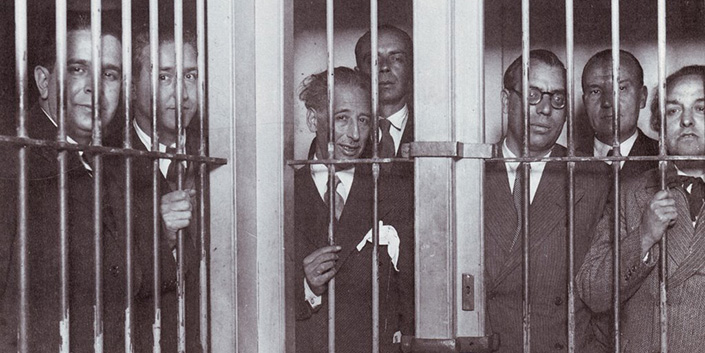
Lluís Companys—center of the photo—and other members of the Catalan government following their arrest after the failure of the bloody coup d'état they perpetrated on October 6, 1934, against the Second Republic.
Companys' 'purges' included the killing of ERC members
A few months after his release from prison, Companys went from being a coup plotter himself to confronting the military uprising of July 18, 1936, which marked the start of the Spanish Civil War. Instead of imprisoning the rebels as had been done to him, Companys ordered the execution by firing squad of 199 military officers who had participated in the coup in Barcelona. This was merely the beginning of a period spanning more than three years, during which Catalonia became the stage for fierce repression against right-wingers, Catholics, and anyone else who stood in his way. In fact, those executed even included 90 members of his own party, the ERC—a situation strikingly similar to the events of the "Night of the Long Knives" in Nazi Germany and Stalin's purges in the USSR.
He had more people executed in three years than the Spanish Inquisition did in a century and a half
The figures are chilling: under the express orders or with the consent of Companys, more than 8,000 people were murdered for their political views or religious beliefs, many of them without a prior trial. The reign of terror unleashed by Companys—an openly Christianophobic politician—targeted Catholics with particular severity: four bishops, 1,536 priests (30% of the Catalan clergy), and thousands of laypeople were murdered simply for being Catholic. Any excuse sufficed to justify these crimes: a disabled religious figure was executed for the sole reason that he knew Latin. The mayor of Lleida, the Catalanist Juan Rovira y Roure, was executed by firing squad for having organized a Three Kings parade. To give an idea of the magnitude of these crimes, I will simply point out that in the Catalonia governed by Companys, more people were murdered in just over three years than were killed by the Spanish Inquisition across the entire Spanish Empire over the course of 160 years (between 1540 and 1700, approximately 3,000 people were executed by that tribunal throughout the territories of the Spanish Crown, according to data available today).
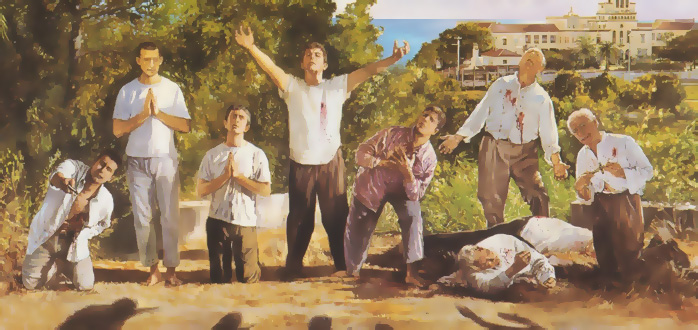
Painting depicting the execution of the Hospitaller martyrs of Calafell, Tarragona, on July 30, 1936.
He turned Catalonia into a far-left dictatorship
In addition to the executions, Companys banned Catholic worship (when asked by a French magazine about its possible restoration, he boasted that "all the churches have been destroyed"), and sent many political prisoners to concentration camps, where the weakest or those unable to work were often simply murdered. Furthermore, under Companys's reign of terror, more than 7,000 religious buildings in Catalonia were destroyed, resulting in the destruction, theft, and looting of a vast portion of Catalonia's historical and artistic heritage. In practice, Companys acted as a totalitarian tyrant with absolute disregard for human rights, effectively turning Catalonia into a far-left dictatorship. The tyrant, elevated to the pantheon of Catalan separatism
Despite his bloody coup d’état against the Second Republic, and despite the terror he unleashed during the Civil War, the fact that he was executed by firing squad—the very method of repression he himself employed against his rivals—leads many today to absolve him of his crimes, honoring him with institutional tributes and whitewashing his legacy in school textbooks. Furthermore, streets are named after him—an honor denied to the vast majority of the victims of his 1934 coup and his wave of terror during the Civil War—victims who are, to this day, consigned to ostracism and oblivion. As I mentioned here two years ago, the fact that nationalism has canonized this savage is further proof of the extent to which that ideology falsifies history and elevates any anti-democrat to its pantheon—provided that the individual in question harbored a deep-seated hatred for Spain.
---
(Main photo: Lluís Companys—at the microphone—delivering a speech on September 11, 1937)
|
Don't miss the news and content that interest you. Join Counting Stars for free on Telegram: Click here to join |




Opina sobre esta entrada: