    |
|
|
|
 |
|
|

This Thursday, November 26, was a big day for the Frecce Tricolori, the aerobatic team of the Italian Air Force.
On Tuesday, the Italian aerospace company Leonardo had already provided a preview by releasing this video, accompanied by the text: "Three colors. Infinite emotions. A new chapter is about to begin."
Tre colori. Infinite emozioni.
Sta per iniziare un nuovo capitolo.#StayTuned pic.twitter.com/Zcf4vp3Efx
— Leonardo (@Leonardo_IT) November 24, 2026
It was no mystery at all. Two years ago, Pininfarina had already announced the new livery for the Frecce Tricolori—a design by the prestigious Italian firm, well-known for its automotive work. This Thursday at 19:50 CET, Leonardo finally unveiled the first M-346 PAN for the Frecce, sporting its beautiful new livery:

At 20:31, Leonardo posted this video showing the painting process for this first aircraft, accompanied by text that began with this quintessentially, passionately Italian phrase: "There are emotions that transcend generations, stories that become part of a nation’s identity, and symbols that speak to its excellence."
Ci sono emozioni che attraversano le generazioni, storie che diventano parte dell’identità di un Paese e simboli che ne raccontano l'eccellenza.
Con l'M-346 PAN di #Leonardo e la nuova livrea firmata da Pininfarina, le Frecce Tricolori dell’Aeronautica Militare… pic.twitter.com/OrpqrLGHgo
— Leonardo (@Leonardo_IT) November 26, 2026
This Friday, Pininfarina released this video of the maiden flight of the first M-346 PAN:
Two years after its unveiling, the new livery designed by Pininfarina for the Frecce Tricolori took to the skies for the first time yesterday.
A vision brought to life, celebrating Italian identity through elegance, dynamism and the beauty of flight. pic.twitter.com/Xoq5AOUejQ
— Pininfarina (@PininfarinaSpA) November 27, 2026
Leonardo’s website has published a comprehensive and detailed page on the M-346 PAN—an acronym for Pattuglia Acrobatica Nazionale (National Aerobatic Team)—describing it as: "a twin-engine, transonic advanced jet trainer that combines high performance, maneuverability, and state-of-the-art technologies with features specifically developed to meet the requirements of formation aerobatic flight."

The M-346 PAN is a version of the Italian M-346 Master trainer specifically designed for the Frecce. Leonardo will deliver 15 M-346 PAN aircraft to the Aeronautica Militare. The Italian company explains: "Equipped with advanced avionics and digital flight control systems, the aircraft incorporates solutions tailored to the activities of the National Aerobatic Team, enhancing the capabilities of the M-346 platform and offering new opportunities for the development of maneuvers, formations, and aerobatic figures."

This variant of the M-346 is a true luxury for an aerobatic display team. The aircraft not only features a white and colored smoke generator, fed by a ventral tank—that allows for the creation of the Italian tricolor flag in the sky, but each of the Frecce’s jets is also equipped with four video cameras installed at various points on the fuselage. These enable the transmission of real-time footage via a dedicated data link to the event’s ground-based video control room; additionally, four more cameras are available to capture further footage. It is the kind of aircraft many aerobatic teams would dream of.

Its head-up display (HUD) is also adapted for the Frecce’s aerobatic maneuvers, and its flight controls feature an aerobatic mode—known as "Acro Mode"—that specifically manages the movement of the airbrake in a way that differs from its operation during normal flight.
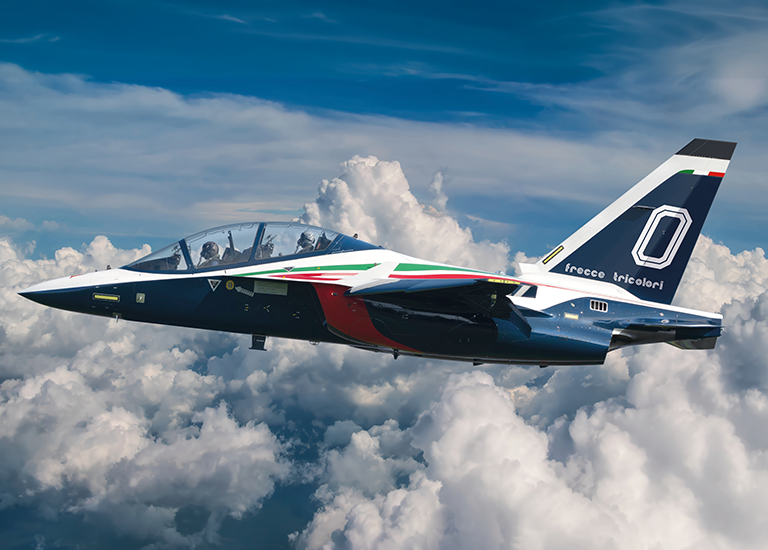
I must admit that, as a Spaniard, I feel a great sense of envy when looking at the new aircraft used by the Frecce. Italy is a country with a significant defense industry that has managed to maintain its autonomy, despite participating in major joint projects with other nations—such as the Panavia Tornado, the Eurofighter, and the NH90. Since 1982, the Frecce have flown an Italian-made aircraft: the Aermacchi MB-339 PAN. Previously, they flew another Italian aircraft—the Fiat G.91 "Gina" fighter, which dates back to 1956—and they will continue to fly Italian-made aircraft, ensuring that their national aerobatic team remains a powerful ambassador for both the Italian Air Force (Aeronautica Militare Italiana) and the country’s defense industry.

The Pininfarina design, which we can see here, adds another Italian element to the Frecce, making them outstanding representatives of Italy on the global stage—both in the realm of defense and in the field of industrial design.

Spain could have chosen that path, but our government opted for the cheap alternative: allowing the Patrulla Águila’s C-101 Aviojets to reach the end of their operational life without a Spanish-made replacement, withdrawing funding from the Airbus AFJT project (which would have provided a domestically manufactured aircraft to replace not only the Aviojet but also the F-5BM), and ultimately purchasing a turboprop aircraft from Switzerland—the Pilatus PC-21—only to end up disbanding the Patrulla Águila just as it was approaching its 50th anniversary. A truly misguided decision—one that now leaves us feeling utterly disheartened whenever we see the new aircraft flown by the Frecce.
---
Photos: Leonardo / Pininfarina.
|
Don't miss the news and content that interest you. Join Defense and Aviation for free on Telegram: Click here to join |


Opina sobre esta entrada: