    |
|
|
|
 |
|
|

World War II was a conflict in which aviation played a fundamental role in combat for the first time.
One of the most famous aircraft of that war was the Junkers Ju-87 dive bomber, known as the "Stuka"—short for its technical designation, Sturzkampfflugzeug (German for "dive bomber"). Designed by German engineer Hermann Pohlmann (1894–1991), it made its maiden flight on September 17, 1935. The Stuka carried a crew of two—a pilot and a gunner—with the latter also serving as the radio operator. The aircraft featured an all-metal fuselage and wings and could withstand dives of nearly 80 degrees, making it one of the best dive bombers of the war.

The Stuka's wings featured a distinctive W-shape that allowed the main landing gear to be mounted at the lowest point—thereby shortening it—while the inner section provided clearance for a 250 kg bomb beneath the fuselage. As an attack aircraft, its armament configuration was primarily defensive, consisting of two 7.92 mm MG-17 machine guns in the wings and a twin 7.92 mm MG-81 machine gun at the rear of the cockpit, manned by the gunner. Additionally, it could carry four 50 kg bombs under the wings.

In addition to its weaponry, the Stuka was the first aircraft to actively employ psychological warfare in its operations. Mounted on the fairings of its front landing gear were two small propellers—known as "Lärmgerät" (noise-generating devices) —designed to produce a siren-like sound intended to sow panic among the enemy. These devices were popularly known as "Jericho Trumpets."
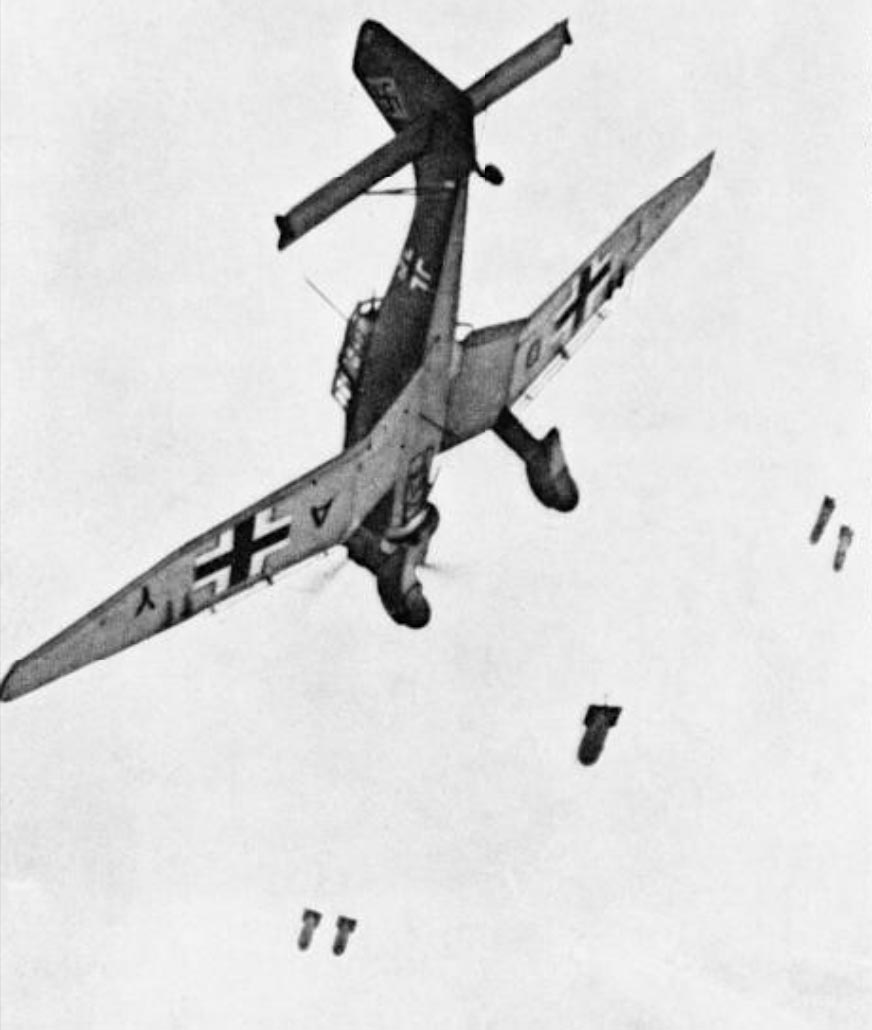
The Stuka saw its first combat action during the Spanish Civil War, having been deployed with the Condor Legion (the unit of German volunteers fighting for the Nationalist side) in August 1936. Its use in Spain was strictly experimental and covert; indeed, all of the Condor Legion's Stukas were returned to Germany following the war's conclusion in April 1939. The German Luftwaffe employed the Stuka in September of that same year during the invasion of Poland, where it served as a cornerstone of the offensive strategy known as Blitzkrieg (lightning war). The aircraft saw service on every front where Germany fought during the war.

Between 1936 and 1945, approximately 6,000 Stukas were manufactured, yet only three original examples survive. One is housed at the RAF Museum in London, another at the Museum of Science and Industry in Chicago, and a third is currently undergoing restoration at the Flying Heritage & Combat Armor Museum in Everett, Washington. If you would like to learn more about this aircraft, Blue Paw Print (a YouTube channel I highly recommend subscribing to) has just released an excellent video showcasing the Stuka’s interior, construction, and operation:
---
Image: Meta.ai.»
|
Don't miss the news and content that interest you. Join Defense and Aviation for free on Telegram: Click here to join |


Opina sobre esta entrada: