    |
|
|
|
 |
|
|

There are some very curious episodes in the history of navies, but few are as curious as that of the American battleship USS Nevada (BB-36).
A ship launched in 1914 and which participated in the World War I
This ship was the first of its class (only one other like it was built, the SS Oklahoma BB-37). It was launched on July 11, 1914 and assigned to the US Navy on March 1, 1916, serving in the Atlantic Fleet. It had 10 356 mm guns distributed in four turrets (two abreast and two more abreast), in addition to 21 127 mm guns mounted in individual casemates along the hull. Its offensive armament was completed with four 533 mm torpedo tubes. In addition, it had six 76 mm anti-aircraft guns mounted in two turrets, a very modest defense for a time when military aviation was still in its infancy and its full potential was still unknown.

The USS Nevada participated in World War I as an escort, never once engaging in combat with the enemy. During the interwar period, the ship was modernized between 1927 and 1930. Among other improvements, two catapults were added to launch two Vought O2U-3 Corsair observation biplanes, and more anti-aircraft artillery was added. Following this upgrade, she was assigned to the Pacific Fleet.
It was severely damaged in the Japanese attack on the Pearl Harbor naval base
On December 7, the USS Nevada was moored at Pearl Harbor Naval Base in the Hawaiian Islands. At dawn, on the ship's deck, the ship's band was playing "Morning Colors" to accompany the raising of the American flag when Japanese planes made a surprise appearance over the base (a moment captured in the excellent 1970 film "Tora Tora Tora").

The Nevada's gunners rushed to their stations and began raining fire like demons down on the attacking aircraft, just as the ship got underway. At that moment, a Japanese Kate torpedo plane launched a 460 mm Type 91 torpedo that hit the ship's port hull just above the keel. The torpedo plane was shot down just after launching the torpedo by the USS Nevada's anti-aircraft gunnery. Although the ship withstood the impact, water leaks opened. The damage control team was able to deal with the flooding, and the ship got underway half an hour later. By then, her gunners had shot down three more aircraft.
In the second wave of the attack, the ship was attacked by dive bombers attempting to block the port access, rendering it useless for months. Five bombs hit the battleship, severely damaging it. The ship was brought to shore to avoid sinking in deep water and to attempt repairs. During the attack, 60 crew members of the USS Nevada were killed and 109 were wounded. It is estimated that the ship ultimately received ten bomb hits.
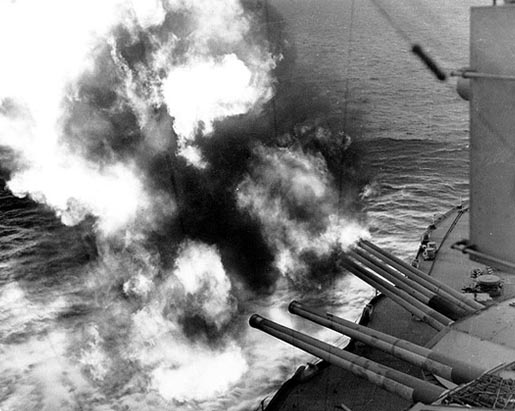
The USS Nevada participated in the Normandy and Iwo Jima landings
In the following months, the ship was refloated and sent to the mainland for repairs and modernization. The work was completed in October 1942, which included an increased number of anti-aircraft guns. The ship served in Alaskan waters and, after further modernization, was sent to the Atlantic, where she was assigned to escort duties (by then she was an aging ship). Once in England, the USS Nevada was chosen as the flagship for the naval operations of the Normandy landings, being the only surviving battleship from the attack on Pearl Harbor to participate in that battle. As part of the attacking fleet, it was responsible for the naval bombardment of the German defenses on the Cherbourg Peninsula.
Later the battleship was reassigned to the Pacific Fleet, arriving at Iwo Jima on February 16, 1945, participating in the naval bombardment that preceded the famous American landing on that Japanese island. In March 1945 she also participated in the capture of Okinawa, where the USS Nevada was hit by a kamikaze plane that killed 11 of its crew. By July the ship was back in service. The ship saw the end of the war in Tokyo Bay.

His sad fate after the war: being a target for atomic tests
Once the war was over, the USS Nevada returned to Pearl Harbor. The ship was 32 years old and already very outdated, so it was destined for a rather sad end for a ship that had served so formidably: to be a target for the July 1946 atomic tests at Bikini Atoll in the Marshall Islands. The ship was designated as the primary target for the first of the atomic tests, the so-called "Able": an atmospheric explosion that would occur directly above the USS Nevada. To make it easily visible to the aviators who would drop the bomb, the ship was painted entirely reddish orange. Nevertheless, the bomb fell hundreds of meters from the ship, which, despite the powerful explosion, did not sink.

The USS Nevada also survived the second Bikini atomic test, dubbed "Baker," which was the first underwater atomic explosion in history. Although it did not sink, the ship was badly damaged and affected by radiation. In August 1946, it was taken back to Pearl Harbor. Once there, it was used as a naval target for gunnery practice on July 31, 1948. But even the naval bombardment it was subjected to failed to sink it. The USS Nevada seemed determined to withstand whatever was thrown at it. Finally, they managed to sink it with a torpedo launched from an aircraft.
|
Don't miss the news and content that interest you. Join Defense and Aviation for free on Telegram: Click here to join |


Opina sobre esta entrada: