    |
|
|
|
 |
|
|

One of the most popular units of the Air Force is celebrating today, and many Spaniards are celebrating with it, as it has been taking care of our mountains for half a century.
The arrival of the first two CL-215s in Spain on February 8, 1971
The Canadair CL-215, a flying boat with two Pratt & Whitney R-2800-83AM radial propeller engines, made its first flight on October 23, 1967. The aircraft was specially designed as a firefighter, with a 5,346-liter water tank that was filled by landing on the water via scoops on the underside of its fuselage. It was also capable of filling up on rivers, reservoirs, and coastal areas. In 1970, the Spanish Ministry of Agriculture decided to acquire two of these aircraft, given their undeniable usefulness in combating the forest fires so common during the summer months.
On this day, February 8, 1971, 50 years ago, those first two aircraft arrived at Getafe Air Base. They were the UD.13-1 (cn1010) and UD.13-2 (cn1013), both built in 1969. These aircraft, along with subsequent ones, were assigned to the 803rd Air Force Squadron, before being transferred in January 1973 to the 404th Air Force Squadron, which moved to Torrejón de Ardoz Air Base in December of that year. On May 8, 1980, the 404th Squadron became the current 43rd Group.

The first two missions took place in Galicia
From their very beginning, these aircraft were closely linked to Galicia: their first mission, a SAR search and rescue operation, was carried out on March 11, 1971, in Finisterre, and their first firefighting flight was in A Coruña on July 9 of that year, still with a mixed Canadian and Spanish crew.It was only the beginning of a long journey that would take these aircraft to Galician soil numerous times, where they not only fought many forest fires, but also carried out maritime surveillance during the "Prestige" oil tanker accident in 2002.
The Ministry of Agriculture ended up buying 30 CL-215
In the following years, more aircraft were purchased, reaching a total of 17 by the 1970s. In 1974, eight new aircraft arrived: the UD.13-3 and UD.13-4 (built in 1972); the UD.13-5 (1973); and the UD.13-6, UD.13-7, UD.13-8, UD.13-9, and UD.13-10 (1974). In 1979, another seven aircraft arrived: the UD.13-11, UD.13-12, and UD.13-13 (built in 1977); and the UD.13-14, UD.13-15, UD.13-16, and UD.13-17 (1978). During the 1980s and 1990s, the fleet was renewed and losses covered with 12 new aircraft: the UD.13-18 and UD.13-19 (arrived in Spain on August 28, 1984), the UD.13-20 (arrived on August 24, 1987), the UD.13-21 (built in 1989), and the UD.13-23, UD.13-24, UD.13-25, UD.13-26, UD.13-27, UD.13-28, UD.13-29 and UD.13-30 (built in 1990).
On August 3, 1989, the Ministry of Agriculture signed a contract to upgrade 15 of the aircraft with turboprop engines, becoming the CL-215T variant. The re-engined aircraft were UD.13-15, UD.13-16, UD.13-17, UD.13-19, UD.13-20, UD.13-21, UD.13-22, UD.13-23, UD.13-24, UD.13-25, UD.13-26, UD.13-27, UD.13-28, UD.13-29, and UD.13-30.
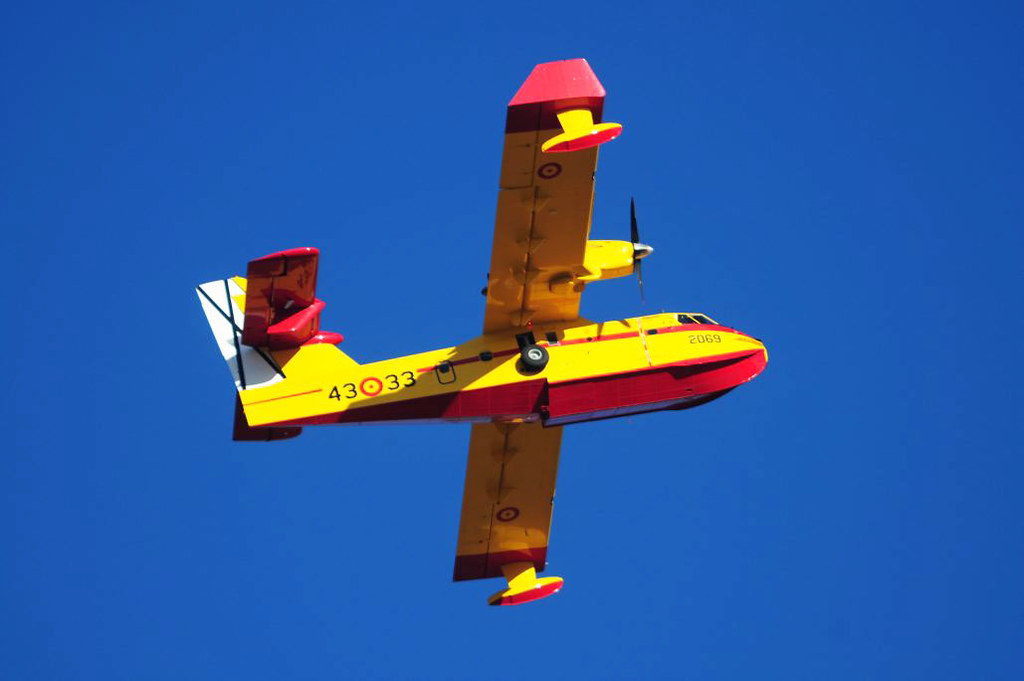
The arrival of the Bombardier CL-415s and the current fleet of the 43rd Group
On July 28, 2006, Spain received its first Bombardier CL-415 (the UD.14-01), a model very similar to the CL-215T but with improved avionics. A second aircraft, the UD.14-02, arrived on August 24, 2008, and the third, the UD.14-03, arrived on September 12 of that same year. The fourth and final CL-415, UD.14-04, arrived on November 29, 2013. It was purchased by the Ministry of Agriculture and was eventually transferred to the Air Force on August 4, 2015. Currently, the amphibious aircraft fleet consists of 18 aircraft:
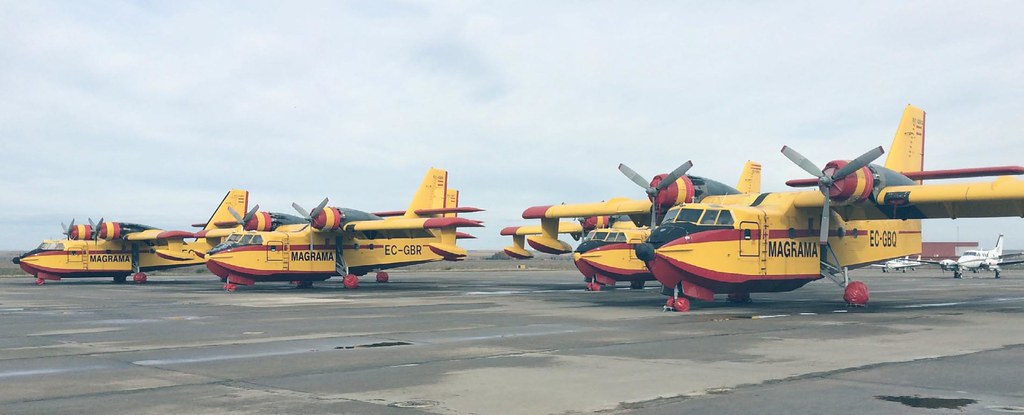
Seven CL-215s continued fighting the fire with civilian registrations.
In 1995, the Ministry of Agriculture transferred the operation of seven of its oldest CL-215s with radial engines from the Air Force to Gestair, operating them from Matacán Air Base (Salamanca) as firefighting aircraft, with civilian registrations and a sign that read "MAGRAMA". These aircraft were EC-GBP (cn1031, ex UD.13-3), EC-GBQ (cn1033, ex UD.13-5), EC-HET (cn1034, ex UD.13-6), EC-HEU (cn1038, ex UD.13-10), EC-GBR (cn1051, ex UD.13-11), EC-GBQ (cn1052, ex UD.13-12) and EC-GBT (cn1054, ex UD.13-14). The management of four of these aircraft (EC-HET, EC-HEU, EC-GBR, and EC-GBT) was transferred from the Ministry of Agriculture to CEGISA between 1996 and 1999. On March 31, 2013, EC-GBP, EC-GBQ, EC-GBR, EC-GBS, and EC-GBT were withdrawn from service and put up for auction in 2015.

The deployment of the 43rd Group to combat forest fires
During the summer period, 14 of the 18 aircraft of the 43rd Group are distributed from their base in Torrejón de Ardoz (Madrid) by detachments at the Lavacolla Military Aerodrome (Santiago de Compostela), the Zaragoza Air Base, the Pollensa Military Aerodrome (Mallorca), the Los Llanos Air Base (Albacete), the Málaga Air Base, the Talavera la Real Air Base (Badajoz) and the Matacán Air Base (Salamanca).
In September 1986, the Canadair aircraft reached 50,000 flight hours, 75,000 on November 5, 1993, and 100,000 in August 1999, making the 43rd Group one of the most active units in the Spanish Air Force. Currently, the Air Force's CL-215T and CL-415 aircraft operate under the command of the Military Emergency Unit (UME).
Canadair accidents in Spain and those fallen
The Spanish Air Force has lost eight of its Canadair aircraft (seven CL-215s and one CL-215T) in as many accidents, five of them fatal. A total of 15 crew members lost their lives. The accidents were as follows:

To these accidents must be added the one suffered by a Canadair CL-215 of the Spanish company Babcock, leased by the Government of Portugal, in Lobios (Orense), on August 8, 2020. The aircraft (CN1034, above) had belonged to the Spanish Air Force, then bearing the registration UD.13-6. Its pilot, the Portuguese Jorge Manuel Santana Jardim, died instantly in the accident. On September 21, the co-pilot, the Spaniard Maximiliano Plaza Bretón, who had been seriously injured in the accident, also died.
I end this post with this beautiful video from the YouTube channel Canadair 415 paying tribute to the crew members of the 43rd Group who died in the line of duty:
|
Don't miss the news and content that interest you. Join Defense and Aviation for free on Telegram: Click here to join |


Opina sobre esta entrada: